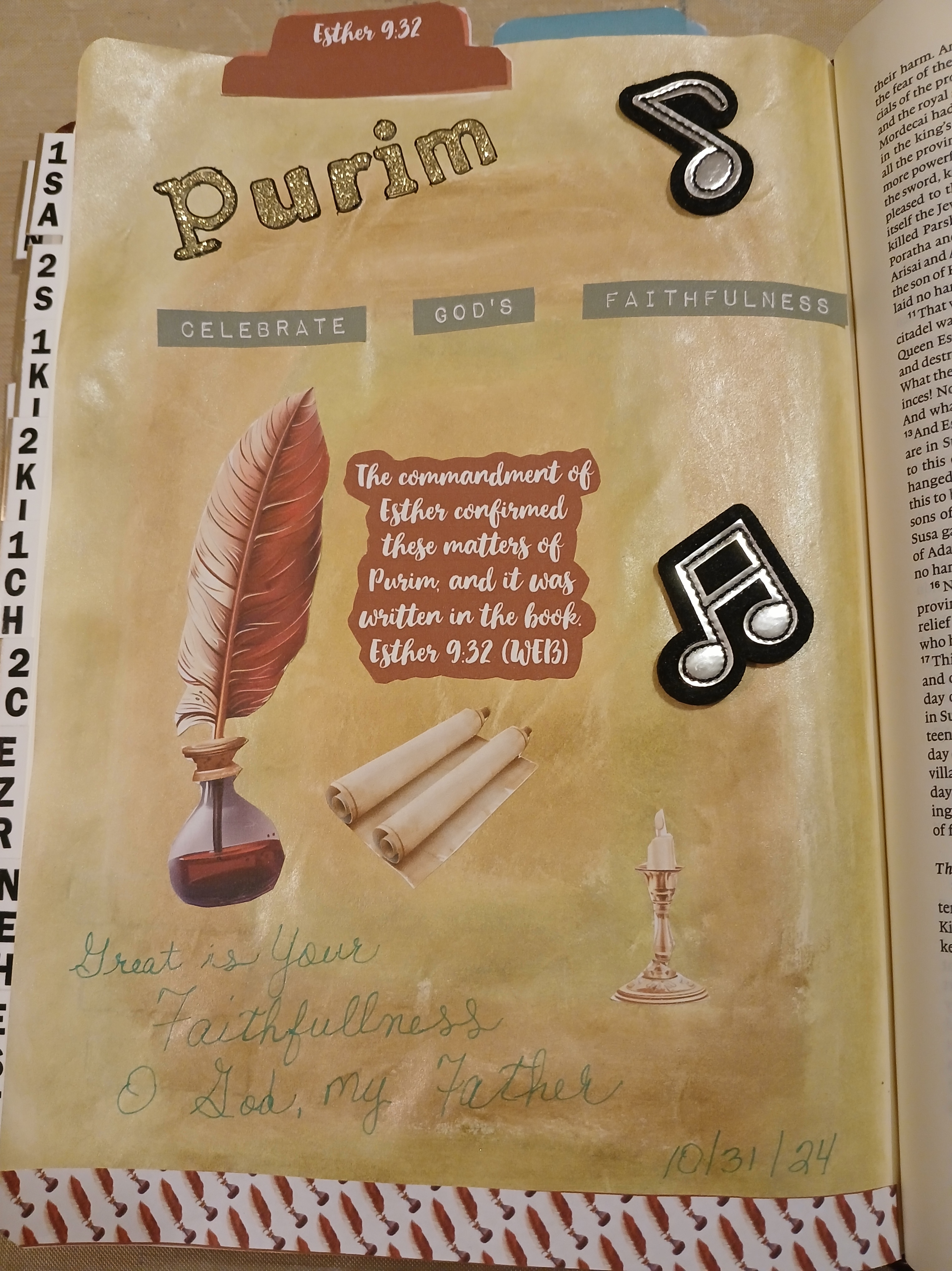
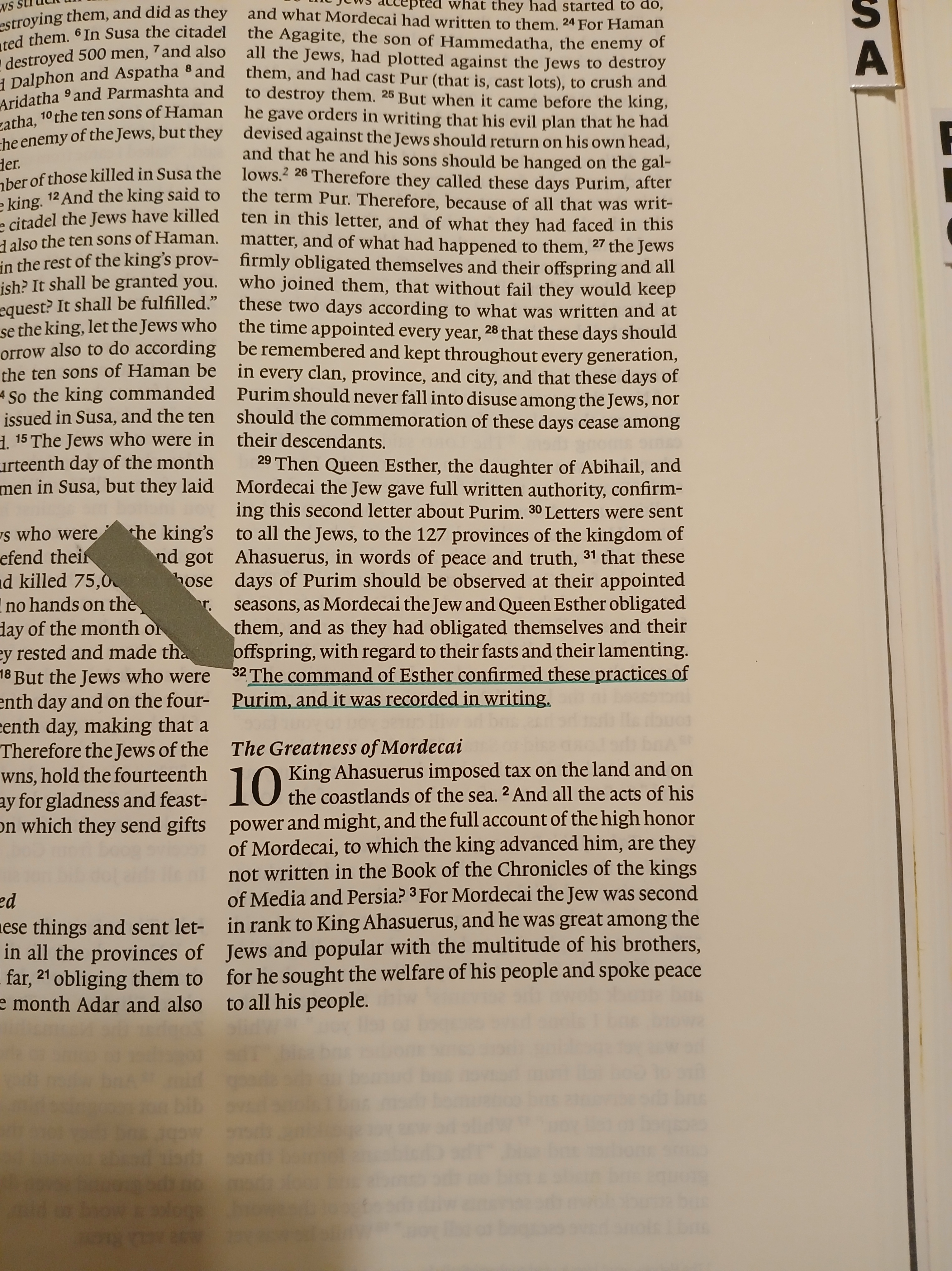
The death of Haman is not the end of the story of Queen Esther’s rescuing of her people. King Ahasuerus told Esther and Mordecai to write an edict of the kind of punishment to be given to those who went against the Jewish people. The edict was written, and the King put his seal upon the edict, which was sent to all the provinces in his kingdom. The edict stated that the Jewish people had the right to defend themselves, and to kill any who would go against them. They destroyed all their enemies but did not take any of the plunder. Then a time of celebration was inaugurated among the Jewish people. That celebration is known as Purim, a time of feasting, celebration, and giving gifts of food to one another in thankfulness for what God had done in saving the Jewish people from being exterminated in Persia. The book of Esther tells us, “The command of Esther confirmed these practices of Purim, and it was recorded in writing.” (Esther 9:32 ESV)
As I read this account, I was impressed by one thing. Each time the Jewish people conquered their enemies, the Bible is very intentional in saying, “they laid no hands on the plunder.” (Esther 9:10 ESV) I wondered why it was important that they just killed their enemies, but not take any spoils from their conquests. Rev. Justin Marple, a Presbyterian minister, says on his website. “One of the curiosities of the text is why the Jewish people did not take plunder even though the decree issued by Mordecai allowed it. First of all, that decree simply was the reverse of the decree issued by Haman. But it is also important that the Jewish people recognized that they were bound by the decree of God more than it. That is, this is part of the ongoing holy war with the Amalekites, which included King Agag (Haman’s ancestor). Therefore, since they were not permitted to take plunder in God’s original decree concerning that war neither did they take plunder in this part of that ongoing war. After all, someone else from the tribe of Benjamin had been king of Israel (namely, Saul) and one of his faults was in taking plunder in his battle with King Agag. So even though there is no mention of God in this entire book the Jews thought of themselves as His army in this fight. The thrice mentioning of the Jews not taking plunder from the Agagites in the kingdom of Persia emphasizes that this generation succeeded where King Saul had failed.” As I remember the situation with King Saul, what pops out to me is when the High Priest, Samuel, reprimanded Saul on what he had done, he reminded Saul, “to obey is better than sacrifice.” (1 Samuel 15:22 NASB 1995) The Jewish people were careful to obey God’s edict concerning the taking of plunder from the Agagites.
Why call the feast “Purim?” Because, if we remember, Haman and his cronies cast lots in deciding when to destroy the Jewish people. In Hebrew, “Purim,” means “lots.” And so, by the casting of lots the date was established to destroy the Jews. However, after Haman’s plot was discovered and he was hung for his evil plan, the feast held by the Jews is called Purim to remind them of how God delivered them through Queen Esther.
The website, The Jewish Road, tells us how this applies today. “We can see historically how Scripture chronicles the way foreign powers have tried to wipe out the Jewish people. We see it in Exodus, as well as in Esther, and even into our modern era with the Holocaust. God has been faithful to His promises as Malachi (3:6) reminds us: ‘For I, the Lord, do not change; therefore you, O sons of Jacob, are not consumed.’”
Much as it was for the Jewish people in Esther’s time, as Believers, we cannot assume that we will be “safe” from persecution. The Bible tells us that in the end times, Christians, as well as Jews, will be persecuted. What I take away from the book of Esther is that God will take care of His people, be they Born Again Believers or His Chosen people, the Jews. Our responsibility is to evangelize and bring people to the foot of the Cross to be saved and to be obedient to His Word in everything we do and say. That is one reason for celebration. We must remember, “ And we know that all things work together for good to them that love God, to them who are the called according to his purpose.” (Romans 8:28 KJV) We should celebrate His work in our lives!

 donnasmusings